



National ULR Networking Event 2026 in Leicester
November 4 2026
The CWU’s National ULR Networking Event 2026 brought together Union Learning Representatives from across the country to celebrate the positive impact of union-led learning.
Delegates were welcomed with a lively Indian dhol performance from Drumology, setting the tone for a day focused on learning, inclusion and empowerment.
Opening the event, Paul Dovey from the CWU Education, Employment and Development Department reflected on the importance of lifelong learning, noting that our evolution as a species depends on us all learning from each other and that history shows good ideas being shared and spread across the world, across different people and cultures. He highlighted the vital role ULRs play in supporting members to access education, build confidence and develop new skills. He argued that education matters more now than it ever has. The spread of disinformation requires us all to have the skills to analyse our sources, to understand how the internet works, to understand statistics, economics and ecology; to learn different languages, so we can talk to each other; to learn arts and crafts, so we can make things that are useful and beautiful. We also need understand both the potential and the pitfalls of AI to make it people-centred AI, rather than the mass-production Tec-Bro hype that cuts jobs, cuts corners and cuts standards. He finished by welcoming the reinstatement of the Union Learning Fund (ULF) but warned that it needs to reflect where we are now, rather than harking back to the 1990s, pointing out that the CWU used the ULF to set up sustainable ULR networks that survived where many others didn’t. We need it to support and improve what we have, not drag us back into unnecessary bureaucracy. We need clear government support for ULRs – and most of all we need fully funded courses for our members. Skills are transferable, so are confidence, hope and solidarity.
Adam Alarakhia welcoming delegates to Leicester
Delegates were welcomed to Leicester by Adam Alarakhia from Leicestershire Amal Branch, who explained Leicester’s rich and diverse history, as a travel hub going back over 2,000 years. He highlighted the contributions of the Windrush generation and South Asian communities, Leicester’s anti-racist activism during the 1970s, and the landmark Imperial Typewriters Strike of 1974, demonstrating the power of solidarity in challenging discrimination and advancing equality.
Delegates then heard from Gawain Little, General Secretary of the General Federation of Trade Unions (GFTU), who highlighted the wide range of courses available to CWU members through our affiliation, including Labour History, Equality, Politics, Economics and Industrial Relations. As an example, he explored the history, purpose and values of the trade union movement. He outlined the work of the GFTU in supporting affiliated unions through education, training and campaigning, while also discussing the challenges posed by the rise of far-right movements and the importance of solidarity and collective solutions.

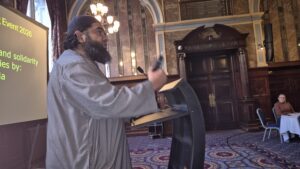
Stiofán Ó Nualláin exploring the political economy.
The next speaker, Stiofán Ó Nualláin, delivered a thought-provoking session exploring the democratic importance for all workers and citizens to understand political economy. He encouraged delegates not to think of economics as something that was beyond our understanding, but to instead realise that understanding economics was key to understanding our politics. He explored the emergence of neoliberalism, its impact on workers and public services, and the growing wealth inequality that has developed since the 1970s. He explained how from being a minority viewpoint among many it has recently entrenched itself as the dominant voice, drowning out and marginalising all others, resulting in vast wealth inequality. He examined how historically, economic insecurity and inequality have always created fertile ground for divisive political narratives and the rise of populist and far-right movements.
The afternoon programme began with an engaging and interactive poetry workshop led by author and poet Emma Purshouse. Emma explained the impact and benefits of creative writing activities upon mental health, improved literacy, celebrating and valuing our communities’ cultures and histories and our own personal histories. Delegates worked together to create and share their own pieces of writing, demonstrating how creative learning can build confidence, encourage self-expression and support wellbeing. Emma encouraged ULRs to think about setting up their own poetry and creative writing groups, pointing out that it was the most democratic art form, needing only a paper and pen and a space to meet.
A further session from Paul Newsham and Paul Dovey focused on community learning, giving examples of the sort of community learning workshops that ULRs could explore with their members. Paul Newsham explained how ULRs in the North West had explored the history of the Rochdale Pioneers and the co-operative movement and how this had led to links with modern community initiatives such as Liverpool’s Roots of the City gardening project and Fans Supporting Foodbanks organised by Liverpool football supporters. He then explained how they had wanted to widen the initiative to look at other aspects of community learning and recruited Paul Dovey to explore the issues of housing. Coming from West London, Paul explored the history of housing inequality and community activism in Paddington, Ladbroke Grove and Notting Hill, from the 1800s when the area was mostly fields, through to the present day. A short but powerful video illustrated the social and political developments that have shaped the area, including the Notting Hill race riots, the Homes for Votes scandal, the impact of gentrification and the lasting legacy of the Grenfell Tower fire. The presentation highlighted the links between housing, social justice and community empowerment. These sessions are available online.

Kate Hudson giving the Ken McKenzie Award to Sandra Absalom

Kate Hudson giving the Ken McKenzie Award to Bev Walmsley
During the afternoon, Kate Hudson, Head of Equality, Education and Development, presented the Ken McKenzie Awards to a number of ULRs in recognition of their outstanding contribution to learning. Recipients included Michelle Laidlaw (Harrow and District Amal Branch), Bev Walmsley (Leeds No. 1 Amal Branch) and Sandra Absalom (South West No. 7 Branch), celebrating the positive impact they have made over many years, enabling learners across the union to access a wide range of accessible and inclusive courses in areas such as digital skills, literacy, numeracy, and mental health awareness, actively supporting those returning to learning after many years or those with additional learning needs. The winners were all recognised for the tenacity, patience and understanding with which they approached their tasks, making them strong advocates for learning and empathetic supporters of learners.

Michelle Laidlaw with her Ken McKenzie Award
In her closing remarks, Kate reflected on the themes discussed throughout the event and highlighted a number of important developments within the department. Delegates heard about new Sexual Harassment Awareness Training and a recently piloted Countering the Far Right course, both of which will be rolled out in the new year. Thanking delegates for their participation, Kate paid tribute to the dedication of ULRs across the CWU and the invaluable work they do in supporting members, promoting lifelong learning and creating opportunities for personal and professional development.