



Prostate Cancer: It’s Not Unique, But Its Very Unique To Me
March 26 2026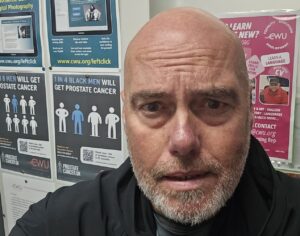
As part of Prostate Cancer Awareness Month, one of our comrades, Brian Parsons, would like to share his experience of the disease. He hopes that by opening up about his experiences he can encourage other men to talk about prostate cancer and check their own personal risk.
1 in 8 men will get a prostate cancer diagnosis in their lifetime, and for Black men this increases to 1 in 4. Prostate Cancer UK have developed a Risk Checker App, which only takes 5 minutes to use. Click here or scan the QR Code below.

Prostate Cancer: It’s Not Unique, But Its Very Unique To Me
By Brian Parsons
In putting my thoughts and experiences in to words, my aims are to simply to highlight the psychological impact of my journey through this condition as well as to dispel any myths or apathy regarding Prostate Cancer.
For the record, over 63,000 men each year will be given the news that they have prostate cancer and sadly over 12,000 of them will die. In this short journal, this will be the one and only mention of statistics. My experience of prostate cancer is not unique but it is very unique to me, very personal to me and it belonged to me, I was not merely a statistic, none of us are.
When writing this, I am still very concerned about the lack of awareness of this condition, apart from men who have been diagnosed and the Urology staff and consultants in the health community, I am also, as concerned regarding the complacency displayed by many uninformed people in relation to the potential severity of this “low level” and “well behaved” cancer.
Like many others, my diagnosis came about through chance and I wasn’t displaying any symptoms, I was diagnosed from a routine blood test, that I was only having because I wished to switch my existing anxiety medication. After a very short period of time I had gone from scan to biopsy to diagnosis, thankfully minus the dreaded finger up the you know what.
On the day my diagnosis was confirmed, I had partly prepared myself for the dreaded confirmation, that said, one of my daughters had insisted coming with me, I was not overly enamoured with the prospect of her hearing the news first hand, especially as I would have preferred to process my feelings alone before drip feeding the information to my loved ones.
On a positive note my cancer assessment score meant I didn’t need immediate intervention, so the start of my prostate cancer journey was non-intrusive and didn’t physically affect my day to day life. Psychologically was a different matter though, I had been dealing with a long term anxiety disorder anyhow and this was always going to be my biggest challenge.
I have to say the consultant and urology nurses were outstanding, they were so informative and honest, which is what I needed, I’ve never been good with over empathy anyway, especially in the medical context, as my ongoing mental state would have immediately had me thinking “what aren’t they telling me, “its worse than they’re letting on” you get the jist. They did go into the treatment options in great detail, as it was only going be a matter of time before I got to the point of my cancerous tumours increasing in size thus threatening my early treatment options and ultimately my lifespan.
The consultant and nurses after just a few appointments quickly became aware that I wasn’t exaggerating when I told them frankly that I feared my anxiety of having to consider the choice of treatments and the side effects would challenge my well-being more than the actual cancer. This is why I’m trying put into words the psychological impact that prostate cancer, nay cancer sufferers in general may experience. This aspect may only be of relevance to me or it may resonate with a lot of people.
Obviously, lots of men experiencing prostate cancer will have various ways of coming to terms and processing their feelings towards their cancer. As a man who has had a long term anxiety disorder and certain behavioural challenges, my approach seemed at best illogical to those close to me not to mention the medical staff. I developed a “gallows humour” in my approach to this cancer, however they eventually realised that I had to have an emotional response that worked best for me and that fitted my flawed psyche.
One of the reasons for this is that I had recently entered in to a relationship, an intense relationship both emotionally and physically, basically I’d found love. Based on this, my fear and anxiety was purely focussed on the side effects of the two treatment options, well three options if you count the option to do nothing and take my chances with this condition. On reading this, I may appear to look shallow and fickle, though to me it was a huge issue, bigger than the cancer, bigger than the feelings of my loved ones bigger even than my mortality.
Given that the majority of people who get the news that they have cancer, will say yes, zap me with radiation or get it out with surgery or both, unashamedly I felt the opposite, being a “full partner” a “proper man” was much more important to me. Even my partner was aghast at my priorities, add to this that I had no symptoms, was enjoying new found love and a healthy sex life. Now before I look even more shallow I have to state that there have been periods in my life when I had experienced severe insecurity, I had come through that but it I knew insecurity was always lurking, waiting for any opportunity to reappear with increased vigour. Again, at the risk of looking shallow, my new partner was very attractive, still is, so in my mind, not hers, I was “punching above my weight”.
So, treatment options, I was still dancing around the options, radiation or surgery, surgery or radiation, or do nothing to me it became an avoidance strategy, of which I was very adept. Initially, I was lucky because the consultant deemed no immediate intervention was necessary, just frequent monitoring, of which I was more than happy, though in my mind this was merely a stay of execution and the spectre of choosing a treatment was constantly triggering my anxiety and insecurity.
Fast forward, after another scan and biopsy and an appointment with my prostate cancer team I was strongly advised that the time had come to pick a treatment intervention as opposed to monitoring, as changes within my cancerous prostate had been detected. Initially, I was still very resistant to accept to the advice of the medical team, partly because of my insecurities mentioned previously and partly due to the fact that I felt fine, cancer had still not intruded how I felt physically. I felt the ongoing discussions with the cancer team were hugely frustrating for them and my partner and family. I was obstinate, bloody minded and hugely irrational.
As you can imagine, my loved ones were beginning to become frustrated and despairing of my attitude and outlook. Emotional discussions were a regular occurrence, so much so that my feelings of stubbornness and avoidance were becoming ever more irrational, feelings of “leave me be” “its my cancer” even to the point of me uttering I’d rather choose how I die than when I die. I quite literally had the mind-set that I would sooner significantly shorten my life span in order to be “a full man”. Potential irreversible erectile dysfunction and worse still massive insecurity were my enemies and not the cancer, my cancer to be exact.
Obviously to maintain such a rationale long term for somebody who loves their partner, kids and grandkids was unrealistic and unsustainable. Reluctantly during my next meeting with the cancer team, I cautiously opted for the surgery, which appears to be the preferred option for younger men. In fact my consultant informed me that my condition was still suitable for the nerve sparing prostectomy, the difference being that sparing the nerves gives some possibility of eventually recovering from erectile dysfunction. I was still very sceptical, however decided to reluctantly pursue treatment. This decision process however did not run smoothly, as you can imagine, nothing with me rarely does. Over a number of weeks I had changed my decision to radiation treatment and then ultimately back to the surgical option.
Even though I had now decided to stick with the choice of surgery and been put on the list, the mental battles with my insecurities were raging every day, the constant mental battles were physically draining up right up til the day of my surgery. These issues were confounded by the fact that although I had appeased my loved ones whose only priority was that they wanted me around for as long as possible, my doubts, fears and psyche were now only played out in private, as I just wanted to reassure my family that I was on board with their wishes unconditionally. Holding this public/private impression was thoroughly exhausting.
My irrational thoughts continued even on the day of the surgery, as I was being driven by my partner, she narrowly avoided us being in a minor road traffic collision, her thoughts were, phew that was a lucky escape she said, privately I thought, shit, what a pity, a collision may have delayed my surgery. I have to say, this was not a fear of surgery, I have had a number of abdominal surgeries, I had no fear of needles, anaesthetics etc, my fear was a straight forward fear of what my post – op issues would be. The result of this narrow escape of a valid reason to delay ended up in my operation commencing on time.
If I had to reflect on prostate surgery to others, who I assume didn’t have as many psychological challenges as myself would be hugely positive, a “no brainer” the cancer is removed, job done, recover and get on with your life, being able to be a healthy husband, dad, brother, son or friend. From my own perspective, despite the positive outlook, I personally was still drinking from the glass of life which was much less than half full. My state of mind was a self-fulfilling prophecy, as I had predicted.
Now in the unlikely event of anyone reading this account, they may say this is a hugely negative account of my prostate cancer journey of diagnosis and treatment. Perversely, I would disagree, in fact I actually implore men to get tested, to trust their care team and to take full advantage of the knowledge and expertise of Urology specialists. However, the purpose of this record is to dispel certain myths. In particular, when you are first diagnosed its quite common for friends, colleagues etc to inadvertently dismiss the impact when diagnosed of prostate cancer. The amount of times someone will say “you’ll be fine”, “its only prostate cancer”, “I know loads of men who have had it and their fine”, “my uncle Billy had it, he’s flying now, he’s never been better”, etc etc, frankly it takes you all your time not to say piss off. By the very fact that they may be friends or family spares them your wrath. I still occasionally had those feelings during my recovery too.
Initially during the post op period, I would occasionally say to my partner that before treatment I had normal bladder movements, whilst during the initial post op period I was pissing more than an over excited puppy. I also would make reference to the erectile dysfunction, questioning the wisdom of treatment, even to the extent of trying to use some gallows humour telling my consultant that I missed my cancerous prostate gland and asking any chance of putting it back in. Obviously in reflection these reactions were totally inconsiderate and petulant and based on fear and anger. whilst contemplating treatment I would also use the myth that “you are more likely to die with it than of it”.
This is an out and out myth and when I heard of someone famous who had been diagnosed and heard his prognosis, it immediately lay all those myths and my issues to rest. My negativity disappeared immediately whilst my anger toward the myth tellers and my frustration toward well-meaning people who dismiss the threat of prostate cancer has grown. My huge appreciation for my urology surgeon and nurses cannot be quantified, my gratitude to my partner and my family for enduring my irrational thoughts and flippant attitude toward mortality knows no bounds and thanks too to my GP for initiating a blood test, not related to any prostate cancer symptoms. I’m still here and not a statistic because of the people mentioned above and definitely not because of me, THANK YOU.

Thank you to Brian for sharing his story. If this has encouraged you or someone you love to check their risk, you can do so with the Prostate Cancer UK Risk Checker App. Click here or scan the QR Code below.
If you are a CWU Rep or ULR who wishes to share this information in the workplace, you can find printable resources here.